


.jpeg)




Dhamrai – A Proud Heritage

Today, Dhamrai proudly stands tall with dignity,
and can confidently say that it has given birth to a remarkable number of educated, knowledgeable, scholarly individuals and PhD holders—making it one of the most distinguished regions of the country.
Dhamrai, a historically ancient and prosperous region, is enriched with knowledge, wisdom, and wealth. The present-day Dhamrai was not always like this in size or position. Over the passage of time, this beautiful and flourishing village has taken the shape of a town.
Long before the Aryans arrived in this land, this region was a flat and fertile plain. Drawn by this fertile soil, the Dravidians came and settled here, building their civilization. During the Buddhist era, this civilization advanced further.
After the Kalinga War, Emperor Ashoka renounced violence, threw away his blood-stained robe, and embraced Buddhism. He took refuge in the teachings of Buddha and adopted the path of non-violence. Later, to spread Buddhism, he selected 84,000 villages. These propagation centers were called “Dharma Rajika” or “Dharma Rajia”.
Dhamrai was one of the most important among these Dharma Rajia centers. The term “Dharma Rajia” means the chariot of religion. It is believed that from “Dharma Rajia,” the names “Dharmaraji,” “Dharmapur,” and eventually “Dhamrai” originated.
Linguistically, “Dham” refers to a house, dwelling, pilgrimage place, or sacred space. “Rai” refers to the youthful Radha, the beloved of Lord Krishna. Thus, the word “Dhamrai” is believed to be a combination symbolizing a sacred abode and Radha’s name.
Today’s Dhamrai stands with pride, having produced some of the most educated, intellectual, and distinguished personalities of the nation.

Here were born and connected personalities such as former Chief Minister of East Pakistan and former Prime Minister of Bangladesh, late Ataur Rahman Khan;
Professor Wadudur Rahman; historic Agartala Conspiracy Case accused K.M. Shamsur Rahman;
Bangladesh’s first PhD holder Dr. Anukul Chandra Sarkar; poet Kamini Roy (daughter-in-law of Dhamrai); Bhaba Pagla of Atma; Sukumar Roy Paladhi of Roail Zamindar family and Divisional Engineer (T&T); Dr. Daud Ali (third PhD of the country);
Dr. Suruj Ali Khan; Dr. Mohammad Qiam Uddin; Dr. Md. Noore Alam; former Finance Minister Dr. A.R. Mallick; wartime Thana Commander and current MP Benjir Ahmed; former MP Barrister Ziaur Rahman Khan; former MP Jamal Uddin; Dr. Md. Mujibur Rahman; Dr. Md. Hanif Ali (CSP); Md. Omar Faruq (CSP); Dr. Abu Kashem; Dr. Md. Lutfur Rahman; Dr. Md. Nasir Uddin; Md. Abdus Sabur (Secretary), along with many other scholars, economists, and freedom fighters.
It is now an undeniable truth that Dhamrai is a historically rich and ancient settlement. The remains of its old architectural structures and terracotta art still bear witness to its glorious past. Excavated burnt clay fragments and soil layers also confirm this history.
Around the year 900 Hijri, five Sufi saints arrived here. Even today, their memory lives on in the Hazrat Panch Pir Shah shrine located in Pathantola, Dhamrai.

The famous Dhamrai chariot (Rath) was world-renowned. One of Dhamrai’s greatest traditions was its famous Rath festival and brass craftsmanship. During the Liberation War, the Pakistani army burned the historic chariot.
This Rath belonged to Lord Shri Yashomadhav Jiu of Madhab Mandir, who would travel to his in-laws’ house and return to Madhab Angan on this divine chariot.
Dhamrai is located about 40 kilometers from the capital Dhaka, accessible by both land and water routes. Its climate and environment are favorable for public health.
Educational Institutions:
Hardinge High School (established 1914) and Dhamrai Government College (established 1972) are considered prestigious educational institutions.
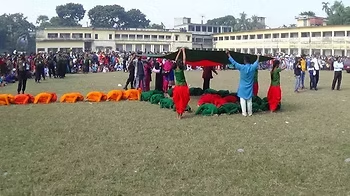
Surrounded by the Bansi River and Kakila Jani River, Dhamrai carries a romantic folklore associated with these rivers. The ancient tales of love connected with these waters may have inspired traditional rituals such as the Trimonha Puja, symbolizing eternal marriage.
The mystical charm of old times, ancient relics, and rows of historical structures still attract both local and foreign tourists to this legendary Dhamrai.
Today, although the village-like appearance of ancient Dhamrai may no longer be visible, its rural culture has not been erased.
Even if traditional drummers and palanquins are gone, hand fans still exist, and festivals like Poush Parbon and Nabanna continue.
Traditional cakes (pitha) have not disappeared, and fairs and gatherings still bring people together.


Comments